Saturday, July 17, 2021

Back to the Classics Challenge 2021 - The Wind in the Willows

I need to get crackin' if I am going to successfully complete the Back to the Challenge this year. I am reading the books just fine. But when it comes to actually blogging about them, I am challenged.

Apparently in a different edition from the one I read, the intro/afterword by Jane Yolen points out that The Wind in the Willows is really three distinct sets of stories: (1) Mole and Ratty, (2) the Adventures of Mr. Toad and (3) the Pan interlude.  I found this break down to be completely accurate and as an adult, I much preferred the snuggly comforts of Mole and Ratty. There’s lots of eating and being cozy and warm by the fire in their chapters. Mr. Toad, while amusing, is likely going to appeal more to readers who are children.  Toad is very naughty and usually gets away with whatever he gets up to, despite his occasional attempts at repentance.  The Pan chapter reminded me of C.S. Lewis in its religious overtones and it is actually the part that gives rise to the title of the book.  

According to the introduction by Margaret Hodges in the edition pictured above that I read (with absolutely stunning illustrations by Ernest H. Shepard), the book was written for Kenneth Graham’s son and was based on bedtime stories he made up for the boy.  Mr. Toad, is in fact based on the young Alistair Graham as a small child, which accounts for much of Toad’s petulant and impulsive behavior…if you have ever met a four year old human, you will know what I mean.  And I did like Mr. Toad’s adventures and found them occasionally laugh-out-loud funny – particularly when his mansion is overrun by piratical stoats and weasels. 

I can also understand why, when this book has been adapted for stage and screen, that only the Mr. Toad parts are included in the adaptation. Mole and Ratty’s tales are really just a succession of meals and naps. But that isn’t to down play them at all. They were absolutely my favorite part and I spent a lot of time thinking about just how I would arrange my cozy den if I were an anthropomorphized mole, water rat or badger. As someone who falls somewhere on the very introverted side of humankind, good friends, delicious meals and a comfortable bed are paradise –just add books to make it perfect. It is interesting that Mr. Toad is the only character who actually gets a proper, human like house, which is spacious, multi-storied and rambling, not close and warm. It also helps that I read this back in February. It doesn’t get that cold in my part of Southern California, but February is typically rainy and, in the evenings at least, chilly. This is a wonderful book to snuggle up to.

I read this for the Back to the Classics Challenge 2021 Children’s Classic category. Many thanks to Cleo at  for giving this book such a glowing treatment last year. It totally lived up to that post and my expectations.

Sunday, July 11, 2021

Back to the Classics Challenge 2021- Orley Farm

 “For many years this prosperous gentleman had lived at a small country house, some five-and-twenty miles from London, called Orley Farm. This had been his first purchase of land, and he had never given up his residence
there, although his wealth would have entitled him to the enjoyment of a larger establishment. On the birth of his youngest son, at which time his eldest was nearly forty years old, he made certain moderate provision for the infant, as he had already made moderate provision for his young wife; but it was then clearly understood by the eldest son that Orley Farm was to go with the Groby Park estate to him as the heir. When, however, Sir Joseph died, a codicil to his will, executed with due legal formalities, bequeathed Orley Farm to his youngest son, little Lucius Mason
.”

The above paragraph is the third one on page one, where Trollope sets up the major plot of the novel. That codicil to the will is contested but ultimately upheld and the mother of the infant Lucius Mason is able to keep Orley Farm for her child and away from the grasping hands of her angry and covetous adult stepson, Joseph Mason Jr. However, some 20 years later, the case is re-opened and the still beautiful Lady Mason isn’t so sure she has the strength to endure yet another lawsuit and trial. Lucius Mason has now reached his majority and wishes to be his mother’s defender in this matter and yet she refuses his assistance and instead relies on that of the family solicitor Mr. Furnival as well as that of their neighbor, Sir Peregrine Orme.   

Ultimately, the question is less is Lady Mason guilty of forgery or perjury and more will she be found guilty of such at the trial. One of the larger questions Trollope is looking at in this novel is the amorality of the law and whether a lawyer is supposed to care more about the truth and justice than they are about their client’s innocence or lack thereof in the eyes of the law. 

Also, of course, there are also multiple romantic subplots and much gentle humor among the handwringing drama. This is a Trollope novel, after all. I found it interesting that Trollope introduces some lower class characters into Orley Farm with the commercial travelers, Mr. Mr. Kantwise and Mr. Moulder. It isn’t unheard of in his novels, but usually he sticks quite closely to the upper middle and upper class in his books. Another interesting character normally not seen in a Trollope novel is the “moulded bride”, young Mary Snow, the low born fiancée of the impoverished yet brilliant lawyer, Felix Graham. Felix, who becomes part of Lady Mason's legal team, is involved in a sort of love quadrangle between himself, Mary Snow, the beautiful Madeline Staverly and young Perry Orne, grandson of Sir Percival. Also among the potential romances are the shenanigans of Lucius Mason and the wily and sly Sophia Furnival and Madeline's brother, Augustus.

I really enjoyed reading Orley Farm. It is a very long novel, but those are often my favorites from Trollope…wherein he introduces many subplots and characters with whom I can get acquainted and involved. There is also some nice continuity with other novels with Mr. Chaffenbrass, another member of Lady Mason's defense, who was previously seen lawyering in The Three Clerks and Phineas Redux.  

I totally gave in to my whim and read Trollope for the Back to Classics Challenge 2021 category “Classic by a Favorite Author”. Unfortunately, in this book as in so many others, Trollope betrays his ugly anti-Semitic attitude, which is a real black mark on him. Not uncommon for the time but I feel I should always call Tony out on this, because there were writers and other people of that era who were not nasty anti-Semites, regardless of the prevailing sentiment. Despite this flaw, Trollope remains next to Charles Dickens, my favorite Victorian novelist. Once a reader is in his thrall, there is no going back, I fear.

Monday, June 14, 2021

Back to the Classics Challenge 2021 - A Grain of Wheat

 Verily, verily I say unto you, unless a grain of wheat fall into the ground and die, it abideth alone; but if it die, it bringeth forth much fruit. John 12:24

My first novel by Ngũgĩ wa Thiong'o but definitely not my last. Ngũgĩ came to my attention sometime around 2010 when I was becoming better acquainted with book prizes and he was rumored to be a front runner for the Nobel Prize in Literature for that year. Mario Vargas Llosa ended up winning instead, but perhaps Ngũgĩ wa Thiong'o will win it in the future at some point.

Set on the even of Uhuru (Freedom), Kenya’s official freedom from the colonial powers of the British Empire in 1963, the story is more or less of centered around the reclusive Mugo. Mugo is so introverted and quiet that those around him fill his silences with what they want to think and hear. What they don’t know is that Mugo is harboring a secret that has been plaguing him for many years, driving him even more away from village society and into a self-imposed isolation. 

Apart from but also connected to Mugo are Gikonyo, a local business man, his wife Mumbi and his rival, the Karanja, who works at the local research station and who is considered a collaborator since he did not fight but worked for British during the war. Mumbi was sister to Kihika, a local hero and Mau Mau freedom fighter who was betrayed which lead to his capture and hanging. The village leaders are trying to get Mugo to give a speech at Uhuru because they believe him to have been a fervent supporter of Kihika and in his own quiet way, a hero of the rebellion. All the characters come to Mugo, in part to try and convince him to speak, but also to confide in him their own troubles and cares. Because Mugo is so quiet, they assume he is sympathetic to them and their feelings. Everything comes to a head on the day of Uhura when old rivalries are settled and the truth about Kihika is revealed.

There is a much smaller side story of the white district officer, John Thompson and his unhappy and unfaithful wife, who will be leaving Kenya after independence because he frankly does not want to be subject to and governed by blacks. His story intertwines with the others because during the war of independence, Thomson was an officer at a detention camp where Mugo was held.  

I really enjoyed this book. It was a great look at Kenya and its history, looking very much at its future and already noting the cracks in the foundation of self-rule. To paraphrase The Who, “meet the new boss, just the same as the old one”. And what to make of this biblical analogy of the death of the seed which brings life to the plant? Is Ngũgĩ using this to remind the reader that the death of colonialism will bring forth the flowering of Kenyan independence?  Or is he referencing the death of the rebel leader Kihika who will bring forth the fruits of self-rule which was achieved in part because of his sacrifices? It is interesting to think about.

I had to read this book quite carefully, because there were a lot of subtle time shifts in the narrative. Also, there was the occasional use of untranslated Kikuyu/Swahili and Kikuyu names took some getting used to in order to differentiate one person from another. But I really enjoyed that aspect of the book because it made the experience more immersive. 

I read this for the Back to Classics Challenge 2021 category “Classic by a POC author”.

Sunday, May 23, 2021

Back to the Classics Challenge 2021 - Setting Free the Bears

For the Back to the Classics 2021 category “Classic About an Animal or With an Animal in the Title”, I read John Irving’s debut novel, Setting Free the Bears which I have owned for many years... ahem… decades.  I think like a lot of readers, if they have read any Irving at all, the first Irving I read was The World According to Garp, after seeing the movie which came out in 1982. For many years thereafter, up to the late ‘90s I was a huge Irving fan and had read his novels (six) published between 1978 and 1998.  I wouldn’t say I am no longer a fan, but for whatever reason, I stopped reading him in the new millennium; well, until recently. 

Anyone who has read a few Irving novels will notice some of his signature trademark tics across his books: Vienna, bears, wrestling, orphans, bizarre deaths, etc. Not every book has every peculiarity in it, but they all have his special brand of epic tragicomedy I believe, at least the seven that I’ve now read. I didn’t encounter any Charles Dickens until 2005, but after having re-read The Cider House Rules in 2019 and now Setting Free the Bears for the first time, it is clear to me that “Dickensian” is an adjective that can be applied to Irving’s novels. 

Published in 1968, Setting Free the Bears is a frame story narrated by Hanne Graff, a Viennese university student. When Hanne flunks out of university, he takes up with the slightly unhinged Siggy Javotnik, a radish eating, salt stealing maniac, and they decide to take a motorcycle road trip. Their goal is to go all the way to Italy and the coast. The opening and closing of the novel are set during their journey in present day mid-1960s Austria, but the middle section is the life history of Siggy’s parents during World War II interspersed with Siggy’s current day obsessive plans to free the animals from the Vienna zoo (hence the title). Also central to the story is a young woman Hanne meets along the way called Gallen at an alpine hotel. Basically, however, Hanne is the straight man to the farcical Siggy and the real story within the story is the history of the Anschluss in 1938 when Nazi Germany annexed Austria and the politics and betrayals of the partisan guerilla forces in Yugoslavia during and after the war.  

The book has its charms and hit a number of the Irving markers (Vienna, bears, orphans) but on the whole, I found it awkwardly plotted, often stilted and generally it felt overly long. All John Irving books are pretty chunky, but as a reader, I don’t normally feel it; in this one I did. I think this book is maybe best left to Irving completists, though possibly had I read it a few decades ago at the height of my love for Irving I would have liked it more. I suspect some of what made it awkward and long was just the creakiness of a debut novel.  Irving was warming up to hit his later stride starting with Garp. I am glad to have read it, however. I particularly appreciated learning more about the annexation of Austria by Germany in 1938 and the political makeup of Yugoslavia under Nazi occupation. I’d never heard of Draža Mihailović and the Chetniks but I think I should have, as should everyone. He was on the cover of Time in 1942, for goodness sake! Google him, I ask you all, if you’ve not heard of him. 


Sunday, April 11, 2021

The 1936 Club: A Shilling for Candles


After missing out on the 1956 club in 2020 because I can’t read a calendar apparently, I am really glad I managed to both READ a book and POST about it for the 1936 Club hosted by bloggers Karen at Kaggsy and Thomas at Stuck in a Book I was super pleased to find I actually owned a copy of A Shilling for Candles by Josephine Tey which was first published in the UK in 1936. I have now read all but one of Tey’s mysteries. On the whole, her books are in my opinion a little hit and miss, but so far all have been well worth reading, even if every title didn’t always blow my socks off.  If you like Golden Age crime fiction, Tey should be on your reading list for sure. 

In the opening chapter of A Shilling for Candles, a man taking an early morning walk on the beach finds the body of woman in a bright green bathing dress who has clearly drowned. He hurries to the nearest coastguard station to phone the police. Unfortunately suicides are not uncommon in this particular area of costal Kent, but eventually the police determine that the woman drowned most likely at the hands of a person or persons unknown based upon a couple of small details about the body. The police also determine that the woman was renting a nearby cottage and that the obvious suspect is her “house guest”, a young man named Tisdall whom she impulsively invited to stay with her when she discovered him about to pawn literally the clothes off his back in London a few days earlier. It turns out that the drowned woman was the famous movie star Christine Clay and that generous, impulsive action of helping a person in need, such as the house guest, was characteristic of her. Who would want to kill her? Was Tisdall? Or her explorer husband who was allegedly out of the country at the time of death? Or was it the composer Jacob Harmer, who was working with her on her current film and who wagging tongues rumor was her lover?

I enjoyed reading it this book. I gulped in down over the course of two days, which was very satisfying. However, I didn’t think this is Tey’s best mystery. The resolution was a little out of left field for my tastes. But up until that point, I enjoyed the investigation along with its obfuscation and red herrings.

There are quite a few colorful characters in the book. There is a really awful journalist, Jammy Hopkins, dogging the detective's, Inspector Grant, heels. The readers are introduced to Grant’s friend and connection to the theater world, actress Marta Hallard who will feature in at least two future books. Grant is an atypical lead detective when compared to literary detectives created by Tey’s contemporaries like Christy, March, or Allingham; he isn’t in and of himself very interesting or quirky. Not that this detracts from the books, however. It is just something I’ve noticed. 

The real highlight for me in A Shilling for Candles was the eccentric Erica Burgoyne, the daughter of the local Chief Constable, who does some mighty good sleuthing in the book.  Tey could have easily spun off a series featuring teenage Erica solving crime, having romantic escapades and cracking wise. 

Interestingly enough, Tey calls out class consciousness front and center when Grant finds out the husband of the victim is a lord and is loath to question him in a confrontational manner. I found it noteworthy that Grant recognizes this behavior and knows it’s not “right” and yet, it’s how one is expected to behave. On the other hand, one of the characters is Jewish and Tey uses some weird backhanded comments on this as an ethnicity which is not atypical for a book published in the 1930s but it is always jarring when I encounter it. 

Tuesday, March 30, 2021

Back to the Classics Challenge 2021 – P.G. Wodehouse


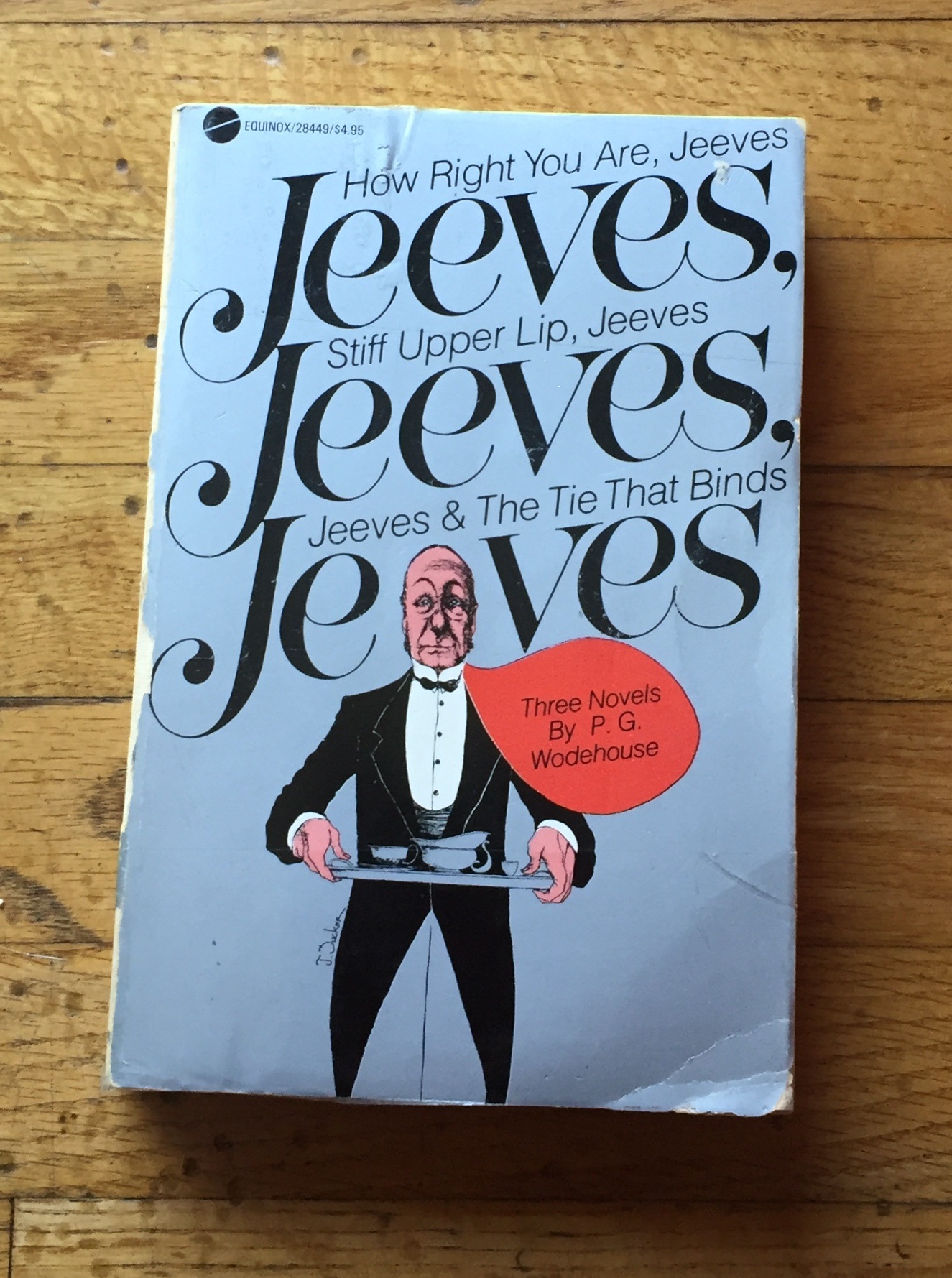
I chose to read some Wooster and Jeeves for the category “Classic Humor or Satire”. I’ve seen a few episodes of the hilarious adaptations starring Hugh Laurie and Stephen Fry but had never read any Wodehouse before. And here I had this chunky  bind up that I bought at a library sale or Goodwill years ago, just begging to be read.  I am so very glad I took the plunge - they were so very, very funny!  

The below listed three titles are sequential but late in the series, published in 1960, 1963 and 1971 respectively. There is a lot to be gained reading them in order, I believe, since there is usually a little throw back to events and characters in previous novels and when I reached the third book, I was laughing out loud while reading.  

So now my plan is to read all the Wooster and Jeeves novels in order. It won’t take me too long to achieve this – a couple of years maybe. There’s a total of 16 novels I believe, but the individual books are fairly short – under 300 pages.  The plots are pretty much all the same, Bertie gets into trouble, usually meaning well, and Jeeves gets him out of it. Some of the humor is in that repetition.

How Right You Are, Jeeves

When Bertie Wooster’s valet, Jeeves, takes a holiday, Bertie heads down to Brinkley Court to stay with his Aunt Dahlia. Dahlia wants Bertie to prevent her goddaughter, Phyllis Mills, from marrying the American playboy Willie Cream, both of whom are also staying at Brinkley Court. Also guests of the manor are Willie’s mother, the thriller writer Mrs. Homer Cream, a novelist, Phyllis step-father, Aubrey Upjohn who unfortunately was also the headmaster at Bertie’s boarding school and has a long memory, and the spunky Roberta “Bobbie” Wickham who tends to get Bertie in trouble whenever she is around. The ridiculous plot thickens and Bertie gets into all kinds of trouble due to both Bobbie and his own silliness.

Stiff Upper Lip, Jeeves

Bertie is induced to return to Totleigh Towers despite the fact that its owner Sir Watkyn Bassett once jailed him for a college prank and frankly can’t stand him. Also, Sir Watkyn’s daughter, Madeline, has vowed to become Mrs. Wooster if her current engagement to Gussie Fink fails. When that affiance is threatened, Bertie has no choice but to enter the lion’s den and patch up Gussie and Madeline’s relationship to avoid dreaded matrimony himself. Of course, many other hijinks ensue: Bertie is (falsely) accused of theft and then kleptomania, spends a night in jail; Jeeves impersonates a Scotland Yard Chief Inspector; a garish alpine hat is sacrificed.

Jeeves and the Tie That Binds

We learn that Jeeves belongs to a club for manservants in which pertinent details of their employers are committed to a book “to inform those seeking employment of the sort of thing they will be taking on”. Bertie is afraid that the book (with an incredible 18 pages devoted solely to him) will fall into the wrong hands. For once, Bertie isn’t wrong. Jeeves and Wooster go to stay at Aunt Dahlia’s with the aim of helping Bertie’s old pal Harold “Ginger” Winship who is standing for Parliament in the by-election at Market Snodsbury. Unfortunately, Ginger’s impetus for politics is his fiancée, Florence Cray, one of Bertie’s old paramours. Also staying at Brinkley Court is Madeline Bassett and her suitor, Lord Sidcup, one of Bertie’s avowed enemies. Without any spoilers, this is the novel where Bertie finally commits to a relationship.

Sunday, March 7, 2021

Back to the Classics Challenge 2021: The House of Ulloa


The earthy and gothic atmosphere of this 19th century Spanish classic novel reminded me at tad of Wuthering Heights in its rustic setting reflecting a landscape of corruption, cruelty and decay, only instead of the Yorkshire moors, the majority of the novel takes place in provincial Galicia. But that comparison only goes so far. Don Pedro Ulloa is no Heathcliff and Pardo Bazán  using the backdrop to tell a story steeped social satire and criticism and not that of a doomed, star-crossed relationship and ghosts. 

The book is narrated in close third person through the eyes of Father Julian, a naïve, very young priest who has been commissioned to come to the Ulloa estate and manage it for the marquis, Don Pedro. However, Father Julian is entirely out of his element. The house and farms are, in fact, “run” by Don Pedro’s farmhand/huntsman, Primitivo, who has the lazy, feckless Don Pedro completely under his thumb. The more Julian tries to get a handle on the situation, the worse it becomes. When Don Pedro marries, Julian hopes this will change the balance of power on the estate, but things don’t work out as he hopes and Julian’s chaste but close relationship with the new mistress of the house is also threatened. Then, when the entire region is in the grips of a local election where Don Pedro has been made the candidate for the conservative faction, things come to a head. 


One factor of the novel that I particularly enjoyed was the descriptions of the countryside, which is rough, wild and sometimes bleak but also beautiful. The comparison of this provincial landscape is juxtaposed with the dissipated and claustrophobic atmosphere of Santiago de Compostela, where Father Julian and Don Pedro go to visit the marquis’ cousins and find Don Perdo a wife. 


The backdrop of the novel is the Glorious Revolution which took place in Spain in 1868 when Queen Isabella II was deposed and exiled. Of course, I know virtually nothing about Spanish history, so getting even an inkling of that background was great in the context of the novel and in the notes in the annotated Penguin edition that I read. It’s a pity that more books by Pardo Bazán are not available in English, though maybe more are in the works?  In the introduction, it was suggested she is often compared to Emile Zola, a comparison she personally disagreed with. But, while I’ve only read two books by Zola, I can see where one might make the comparison, in particular because Pardo Bazán is quite frank about the more earthy and realistic sides of life. 


I read this for the Back to the Classics Challenge 2021 category “Classic by a New to You Author”. I was introduced to The House of Ulloa and Emelia Pardo Bazán by the blogger Sylvia Cachia. Thanks Sylvia!