Showing posts with label BACK TO THE CLASSICS 2016. Show all posts

Wednesday, November 2, 2016

BACK TO THE CLASSICS CHALLENGE 2016 WRAP UP POST


I managed to read all 12 books for the challenge by September, but (a) quite a few were short-ish (less than 300 pages), (b) 3 of the longest were by Trollope, Dickens and Whipple who are writers I love and so am able speed through their works, despite any heft and (c) I did some business travel this year, which is rare for me, which did allow me to get a lot of reading done in hotels and airports.
  • The first book I read was for the category A Classic Detective Novel.   The Franchise Affair by Josephine Tey is the fourth book I have read from her.  It was a good mystery (and refreshingly bloodless) but there was quite a bit of virulent class prejudice that was a bit hard to swallow.
     
  • The next book was The Small House at Allington by Anthony Trollope which was for A Classic Which Includes The Name Of A Place In The Title.  This is the fifth book in the Barsetshire Chronicles and I absolutely adored it.
     
  • I went on to read The Lost World by Arthur Conan Doyle which ticked the box for An Adventure Classic.  The book was a lot of fun, but its dated racism soured the experience for me a bit.
     
  • The fourth title fit the category A 19th Century Classic, I went with my original pick which was  The Pickwick Papers by Charles Dickens.  I was a little worried that I wouldn’t get on with it at first, but I ended up really loving it.
     
  • I then read Frankenstein by Mary Shelly to fill the spot for A Fantasy, Science Fiction, or Dystopian Classic.  I have to say I was a bit let down by this book, but I think my expectations were impossibly high. I am keeping my copy and will re-read/re-evaluate it at some point.
     
  • For the category A 20th Century Classic I read The Grapes of Wrath by John Steinbeck. This book almost put me into a slump. It is fantastic, but such an emotional journey, it wrecked me just a bit.
     
  • Next up was A Separate Peace by John Knowles which I first read in high school and chose for the category Re-read a classic you read in school (high school or college). I quite enjoyed the re-visit and I think I appreciate the story much more now as an adult than as a teen.
     
  • Then I read Greenbanks by Dorothy Whipple for A Classic by a Woman Author.  Since Whipple is one of my favorite authors, it is no surprise that I adored this title.
     
  • Next up was Lolita by Vladimir Nabokov for the category A Classic Which Has Been Banned Or Censored.  Like The Grapes of Wrath, this book broke me a little bit as well.
     
  • I then read Things Fall Apart by Chinua Achebe to fit A Classic by a Non-White Author. I really enjoyed this book for its insight and subtle complexity.
     
  • My penultimate choice was Bonjour Tristesse by Françoise Sagan, translated from the French by Irene Ash, which fit the bill for A Classic in Translation.
     
  • Finally, for the category A Volume Of Classic Short Stories, I read The Dracula Book of Vampire Stories edited by Leslie Shepard, which was fun but I didn’t find too many of the stories to be that scary.
One of the best things about this challenge is how easy it is in terms of choice and options. Also, like last year, I was able to fill the majority of the categories with titles from my own shelves, which is always a nice feeling: Of the 12 books, two were from the library, seven I already owned and three I bought used for around a dollar each.

Wednesday, September 14, 2016

BONJOUR TRISTESSE by Françoise Sagan


My first thought for the 2016 Back to the Classics Challenge category “A Classic In Translation” was to try something from Collette, since I had never read her and was curious to try.  But I also have this nutty idea to read the entire Rougon-Macquart  series by Zola (I have only read two: The Fortunes of the Rougons and Germinal…only  18 more to go! – cue crazed laughter).  But in the end, I spontaneously decided to go for something different, but still translated from the French interestingly enough. I read Bonjour Tristesse by Françoise Sagan (translated into English by Irene Ash) which was first published in 1954 when Sagan was just 19.  I didn’t realize that this is a novella, but that was a happy surprise in that it didn’t take me long to finish it.

The story is about Cécile, a 17 year old who has been living in Paris with her widowed father and his string of live-in girlfriends for two years since leaving her convent boarding school.  Cécile should be studying for her entrance exams to university, but frankly she can’t be bothered.  Like her father Raymond, she is too busy having fun to worry too much about exams or anything else she finds unpleasant.  She spends most of her time attending parties and social events in her father’s circle of like-minded men and women.  However, when she goes to the French Rivera for the summer with Raymond and his latest gal pal, their family friend, Anne, shows up unexpectedly.  Cécile and her father are drawn to Anne’s common sense stability, a trait they both lack. However, Cécile soon feels threatened by Anne and Anne’s relationship with and influence over Raymond and drama and tragedy ensue.

This book is very much a character study of Cécile. There is some dialog and description but much of the book is inside Cécile’s head. And because she is a spoiled, immature teenager who doesn’t have the emotional experience to navigate the threat that she believes is posed by Anne’s presence, often the inside of her head is a confusing and contradictory place to be.

I liked the novella OK but I am not going to rush and read any further books by Sagan.  It is great when I read a classic and discover a new author with a huge back catalog for me to explore, but when that doesn’t happen, that is OK too!

Tuesday, August 16, 2016

THINGS FALL APART BY CHINUA ACHEBE

Before I’d ever read this book, before I even knew the basic outline of the story, I knew that Things Fall Apart was “supposed” to be a book about the advent of colonialism in Nigeria and the resulting destruction of the indigenous culture. But well over half the book is about Onkonkwo, a successful farmer and leader who is respected (but not particularly loved) in his village. Frankly, Onkonkwo is as rigid and unyielding as any intolerant, colonizing Englishman and/or Christian  missionary. I mean, there has to be a reason that Achebe made his central character so very unsympathetic. Personally, I think that any forceful challenge to Onkonkwo’s belief system would have knocked him for a loop. His entire life was blind faith in tradition, regardless of how such tradition made him feel or how it affected his loved ones and I am not sure just how much this book was intended to be an indictment of European colonialism as I had been led to believe. I realize that Achebe wrote further books that are loosely considered to be part of a series, so perhaps those books address this topic more specifically.

I was not super keen on the storytelling style of this book. It just is not my taste; very simplistic and bare-bones, which totally suits the story, but it isn’t something I particularly enjoy. And the title, a reference to a poem by Yeats (which I only know because I think Picard quoted on Star Trek Next Generation once), belies that simplicity. What I did like were the little authorial hints about other villages with other traditions, and the glimpse into a tradition and culture which is now most certainly non-existent in the form presented in the novel, although bits and pieces surely remain today in modern Nigeria. Even though I didn’t really love the writing style, I think that this is a book that can be understood and appreciated on a variety of levels. It is deceptively simple and subtle.

I read this book for the category “Classic by a Non-White Author” in the 2016 Back to the Classic Challenge hosted by Karen on the blog Books and Chocolate. I am glad I finally got to it since it has been on my list for many years and particularly I wanted to read it before I tackled Chigozie Obioma’s The Fishermen since my Father told me that one could see a definite link between the two books.

Tuesday, July 19, 2016

Lolita by Vladimir Nabukov

No plot summary needed because I think most people are well acquainted with this particular story. I read this book as my choice for the “Banned or Censored Classic” for the 2016 Back to the Classics Challenge hosted by Karen at the blog Books and Chocolate. This book was banned in the UK  and in France, in the late 1950s although it was eventually published in both countries. I can’t find any Internet evidence, however, that it was banned in the U.S. at all which really surprised me, given that Forever Amber was banned less than 10 years earlier and having read both, I would say that Lolita is more explicit and much, much more disturbing.

I read Reading Lolita in Teheran a few years ago. Probably mostly because the title alludes to it, but I specifically recall  Azar Nafisi’s deconstruction of this novel.  In particular she elucidated on how Humbert Humbert not only physically imprisons Delores, but how he denies her her own existence outside of himself figuratively and metaphorically as well. This is something I thought a lot about as I read Lolita.    

 I know that Nabokov is revered for his writing but I wasn’t really able to appreciate it as such. I realize there is a lot that I missed; references to other works, etc. But even if I could unequivocally state that this was the best written novel ever, it is, in my opinion, a very unpleasant story and no amount of Humbert Humbert's charm can deflect from that.  There are a few books that I have read where I am sure that I would have appreciated them more when I was younger, but this is a book that I am glad I read when I was older and somewhat wiser. I don’t know if I would have been able to see past some of the roadblocks that Humbert puts up had I been a younger and more naïve reader.

I don’t know what Nabokov’s intent was when writing this book, but clearly publishers and the public at large have also been seduced by Humbert Humbert. Just look at the freaking cover art for most of the editions of it (thankfully mine published by Everyman’s Library only has a photo of the author); why is Delores objectified again and again? Why do we use the term culturally “Lolita” to mean a “nymphette” as defined by Humbert? These facts are as disturbing as the book itself.

Tuesday, June 21, 2016

GREENBANKS BY DOROTHY WHIPPLE


I chose Greenbanks by Dorothy Whipple for my “Classic by a Woman Author” for the 2016 Back to the Classics Challenge hosted by Karen at the blog Books and Chocolate.  This is the third title that I have read by Whipple after The Priory and Someone at a Distance, both of which I just now realize I read for the last two Back to the Classics Challenges! 

I own all three of these books in the Persephone re-issue editions. Whipple was a very popular author in her day, but fell out of favor (and print) until many of her titles were resurrected by Persephone. I believe she is currently the author with the most titles re-published by Persephone; they currently offer seven of her novels and one short story collection.

Greenbanks is primarily the story of Louisa Ashton, the mother and grandmother of a large, middle class family whom she raised in the family home of Greenbanks somewhere in northern England. The book is set in the first quarter of the 20th century and there is a very definite theme running through the book regarding the options and restrictions placed on women across the generations, since Louisa grew up very much a Victorian while her granddaughter Rachel comes of age post WWI.  While Louisa’s grown children and their wives and husbands often mystify her, she has a very special relationship with granddaughter Rachel.

There isn’t much of a plot, but it is easy for the Whipple-loving reader to become immersed in the world of Greenbanks without it because she wrote so well and her characters are so exceptionally well-drawn.  Outside of Louisa and Rachel, who are very sympathetic characters, it is worth mentioning Ambrose, Rachel’s father and the insufferable husband of Louisa’ daughter Letty. Most of the time reader just wants to slap him, but occasionally there are small glimpses into his interior and his genuine incomprehension of other people and their motives and behaviors.  I did actually feel a bit sorry for him from time to time.


I find there to be something comforting about the way Whipple writes and the kinds of stories she tells, even though she doesn’t shy away from unpleasant subjects or characters. There is a smooth quality to her writing style, if that makes any sense, that keeps me turning the pages and I very much look forward to trying one of the further 4 Whipple titles from Persephone in future. 

Friday, June 10, 2016

A Separate Peace - Back to the Classics 2016


I first read A Separate Peace as a high school freshman. I can see why this book would be placed on a high school reading list: it is short, the language isn’t too complicated and there are some obvious themes of guilt and redemption to be mined for essays.  This book screams loss of innocence/coming of age.
I didn’t remember too much from back when I first read it, over 30 years ago. On the second read I was reminded of The Lord of the Flies, just with the savagery buried much, much deeper under the surface.  

A Separate Peace is rather dark story of adolescent male friendship.   The narration is given in flashback from the perspective of Gene Forrester, who attended an all-male boarding school located in New England in the mid 1940’s, just on the cusp of the United States entering the war.  Gene is from the south and it is only just barely referenced that his background is less grand, less old-south aristocratic, than he projects to his classmates. To me, this hints at Gene having the tiniest of a chip on his shoulder.
Gene’s roommate and best friend is Phineas (Finny), who is a natural leader, charismatic and popular at the school. Again, it isn’t explicit, but I think it is suggested that Finny is from the right kind of New England Brahman family.  So in short, Gene doesn’t really belong and Phineas does, or at least this is Gene’s perception.

Gene admires Finny, but also wants to set himself apart from him and be recognized for his own merits at school. Gene suspects that Finny is trying to bring him down and sabotage him academically.  Personally, I think the book is ambiguous on whether or not there is any truth in Gene’s paranoia and since the reader doesn’t get any direct insight into Phineas’ headspace, it is hard to say if he is genuine or not.  In any case, Gene’s perceived competition with Finney over their last summer term leads to tragic results.
I re-read this title for the category “Re-Read a Classic from School” in the 2016 Back to the Classic Challenge hosted by Karen on the blog Books and Chocolate.

Wednesday, June 1, 2016

The Grapes of Wrath-Back to the Classics 2016


My pick for the 20th Century Classic (any book published between 1900 and 1966) for the 2016 Back to the Classics Challenge hosted on Books and Chocolate was The Grapes of Wrath by John Steinbeck. My completion of this title is a double whammy, since I am slowly working my way through reading all of the Modern Library's Top 100 and this book is on that list as well. This puts me at now having read 68 out of the 100.   : )

The following quote from Steinbeck about the creation of the Grapes of Wrath was included the introduction by Robert Dermott in the Penguin edition that I read: “I have done my damndest to rip a reader’s nerves to rags …” He certainly met his objective as far as I am concerned; this book wore me out and it made me mad. I admire the novel for its tenacity, but reading it was like figuratively getting punched repeatedly. There were very few light moments, such as when the two younger Joad children use a flush toilet for the first time.

It is amazing to me that the book was researched, written and published during the Great Depression; Steinbeck was writing about something that was happening in real time which gives the novel a real sense of urgency and anger I think. I can understand also why its publication was is/was controversial. Not only is it irreligious and frank about sex, it also is a call to arms politically. However, it is important to note, that regardless of how liberal this book’s politics are, there is only one brief mention of the non-white migrant farm workers of this era. This is not their story even though they must have suffered just as much. And even more discouraging is to think that the type of human exploitation explored in the novel is not something of the past, but continues to happen even now, over three quarters of a century later.

The book has an interesting structure as the longer chapters that chronologically recount the Joad family’s journey from the Oklahoma dust bowl to the alleged paradise of California is interspersed with shorter chapters that read almost like sermons or Tom Waits lyrics.  I found it a challenging read, mostly due to the content.  I had to make myself read parts of it, so I was glad of those shorter chapters because the provided a break from the downward spiral of the family's prospects as they move west.  All in all, a very powerful book which I am glad to have finally read.

Tuesday, May 3, 2016

Frankenstein by Mary Shelly


I found it interesting that unlike other classic literary horror characters such as Dracula or Dr. Jekyll and Mr. Hyde, there is almost nothing in the novel Frankenstein that corresponds with the popular image of Dr. Frankenstein and his monster or the 1931 movie.  The introduction by Maurice Hindel from the beautiful Penguin clothbound classic edition that I read (pictured above) notes that Shelley incorporated what was then cutting edge science (galvanism, ie electricity) to allow Frankenstein to bring his creation to life. But it wasn’t even raining on the night of the monster’s creation in the book…so no thunder or lightening needed.  In fact, there is no description of the making of the monster at all; it mostly happens off the page.
What I like most about the book (besides its length, only 225 pages!) was its structure.  It starts off as a series of letters from a dilettante arctic explorer Captain Walton to his sister back in England. In his letters, he tells of rescuing a man who is near death with cold and exhaustion. Once this man is nursed back to health, he relates to Walton his story about why he is alone out on the ice and within the rescued man’s narrative a first person account of the monster’s short and unhappy life is given. So it is a story, within a story within a story, like a set of nesting dolls.

What I didn’t like was Victor Frankenstein’s constant “why me?” moaning and teeth-gnashing, all the while doing nothing to actively change the situation for which he and his hubris is directly responsible.  It isn’t just that he comes off as unsympathetic, but I found most his behavior unaccountable. I much preferred the monster’s narrative over Frankenstein’s and while the monster’s actions are equally despicable, I feel as if I understand where his motivations lie.  There are also some preeettty craaaazy leaps of faith the read must make in order for the story to hang together. For example, not just that Victor was able to make a man from left over body parts, but also things such as how the monster just happens to find three intact novels in the forest, he just happens to be able to eavesdrop on a Turkish girl learning French enabling him to learn French, etc.  This really strained my credulity.
Of course, what is fantastic about the book is the questions it asks about humankind in the here and now (like all great science fiction). Certainly one of the questions the book raises can be extrapolated to modern man and modern science:  just because we can do something (split an atom, genetically modify corn, clone sheep, etc.) should we?  And just how much responsibility do we have for our creations when they escape our control? But for me, most important and most poignant is the question of who is the real monster of the story.

I read this for the  2016 Back to the Classics Challenge hosted by Karen at Books and Chocolate for the Fantasy, Science Fiction, or Dystopian Classic category

Monday, May 2, 2016

The Pickwick Papers by Charles Dickens

While The Pickwick Papers is considered Charles Dickens’ first  novel, it actually began as a commission to write brief, satirical sketches about a private Gentlemen’s Club to accompany comic drawings for serial publication.  However, Dickens soon convinced his publishers that this should be the other way around and the drawings should be commissioned to accompany his ever mushrooming story regarding the adventures of the members of the Pickwick Club.  [There is also a rather sad side story of the original illustrator, Robert Seymour, committing suicide after the first two issues were less successful than anticipated and whispers of Dickens’ bullying ways contributing to his untimely demise.  Dickens addresses and defends these rumors in the preface to the 1867 edition which was included in the Modern Library Classics edition that I read which is pictured above.]
Since I did know the history of the book prior to reading it, I readily noticed as it went on that the chapters got longer, the plot more convoluted and the character arcs more apparent. Most importantly, the titular Pickwick starts off as object of ridicule but ends up (along with his faithful servant Sam Weller) being the hero of the book. The notion of satirizing private clubs is eventually dropped and replaced with social critiques of Victorian society which will later be more fully expressed in subsequent Dickens’ novels such as Bleak House and Little Dorrit. All this makes for a slightly rambley and inconsistent read and no doubt there were humorous bits I didn’t fully grasp since I am so far removed from the type of society Dickens was satirizing, but nevertheless I did really enjoy it.   
I don’t know if The Pickwick Papers is the best place to start with Dickens, but then again, maybe it is or rather maybe it doesn’t really matter? Martin Chuzzelwit will forever remain my favorite if only because it was the first book of Dickens that I read and made me fall in love. I admit the superiority of certain other works by Boz, but that title will always be on the top of my list for purely sentimental reasons!  And certainly The Pickwick Papers has everything that I love about Dickens, exaggerated characters, humorous pokes at human nature, sympathy for the poor, indignant anger at hypocrisy, etc.   So perhaps this first novel is absolutely the best place to start, because if you like this “sampler’, you will probably like the rest of Dickens as well!

This book was my read for the category of 19ths Century Classic in the 2016 Back to the Classic Challenge hosted by Karen on the blog Books and Chocolate.

Wednesday, March 23, 2016

THE LOST WORLD by Arthur Conan Doyle


I read The Lost World as my Adventure Classic for the Back to the Classic Challenge 2016 at the book blog Books and Chocolate.

The reader’s enjoyment of The Lost World will definitely depend upon her (a) suspension of disbelief and (b) her ability to look past the racial stereotypes of the Victorian/Edwardian era.  Arthur Conan Doyle is, of course, much better known for Sherlock Holmes than for the adventures of Professor Challenger, who  is introduces in this book and who went on to be featured in two further novels and two short stories.  The Lost World was a fun sort of romp in its way, but I doubt I will ever read any further adventures of Professor Challenger. Personally, my window to have read and really enjoyed this type of book was probably some time in my tween to early teen years, back when I did read a couple of Jules Verne and HG Wells books.

The book is very short (less than 250 pages) and the plot is fairly simple: Professor Challenger, a pompous yet intelligent bull of a man, alleges to have discovered a land that time forgot somewhere deep in the Amazon, but no one believes him because all of his evidence was accidentally destroyed upon his return. Intrepid newspaperman E.D. Malone, always on the lookout for a good story, is also seeking out a daring and dangerous assignment in the hopes of impressing the woman he loves.  Malone, along with big game hunter Lord Roxton and biologist Professor Summerlee, band together to travel to the Amazon to try to either prove or disprove Challenger’s claim. Adventure ensues!

As I mentioned above, there are more than a few unfortunate racial stereotypes to be found in the book, along with attempted genocide, slavery, and a general belief in the superiority of “civilized” white Europeans over any other group. I can’t put my finger on why these attitudes bother me in some books but in others (like The Secret Garden), they do not.   What I did enjoy about The Lost World was the sense of adventure and discovery expressed in the story.   It is hard to imagine today that there is a square foot of the earth’s surface that hasn’t already been surveyed and catalogued but I think a person at the turn of the 20th century could very well conceive of an undiscovered island or plateau just waiting for scientific discovery and research.  I also loved the illustrations (drawings and faked photos) in the book. I am a total sucker for that type of thing!

I don’t regret reading this at all, but as I wrote above, I think I read this book too late in life. I had a similar experience with two other Victorian classics: Dracula and The Strange Case of Dr. Jekyll and Mr. Hyde, but for different reasons.  I honestly enjoyed the forward written by Michael Crichton, in the Modern Library edition that I read shown above, more than I did the actual book.

Thursday, February 4, 2016

THE FRANCHISE AFFAIR BY JOSEPHINE TEY


The Franchise Affair is the first book that I have completed for the 2016 Back to the Classic Challenge hosted by Karen on the blog Books and Chocolate and it fills the category of Classic Detective Novel. This is the fourth Tey mystery that I have read and I can say that I am impressed at how they each have been very different from each other, although I don’t think Tey is going to ever knock Agatha Christie of the pedestal on which I have placed her.

The book is billed as an Inspector Grant mystery (he of the famous Tey title Daughter of Time), but actually, he is barely in the story. Instead, the “detective” in this case is an amateur sleuth: Robert Blair is an unmarried, middle aged small town solicitor whose routine is rather thrillingly disrupted when a local mother and daughter are accused of kidnapping and forcing a 16 year old-school girl to work as a maid for them. To say more than that would be to spoil the plot!

I enjoyed the mystery side of the story alright. Although I did think it seemed a little familiar while reading and it turns out that The Franchise Affair is loosely based on a real event that took place in the 1700s (which is obliquely referenced in the book). I soon realized that I read a Guardian article written by Sarah Waters about The Franchise Affair ages ago. A little googling and I was able to find the link; it is really an excellent article: The Lost Girl - Guardian Article, but read it after reading the novel unless you want to get spoiled!  

What I found a little hard to swallow about The Franchise Affair were characters who think they can tell a criminal by way a person’s eyes are set or by the shape of their forehead, etc., that smacks too much of pseudo-sciences like phrenology. So I read much of this book with an entire salt cellar. And as the Sarah Water’s article mentioned above explains much better that I ever could, there is a lot of virulent class prejudice and middle class fear of the lower class expressed in the story, which can be an unpleasant experience for a modern day reader.


Monday, December 28, 2015

Back to the Classics Challenge 2016 - Possible Contenders


It is with great pleasure that I announce my intentions to participate in the 2016 Back to the Classics Challenge hosted by Karen at the blog Books and Chocolate. Below are the categories and the books that I will possibly read:
  1. A 19th Century Classic - any book published between 1800 and 1899. Something by Dickens! I still have 5 of his novels to read...maybe I will tackle The Pickwick Papers or maybe The Old Curiosity Shop...
  2. A 20th Century Classic - any book published between 1900 and 1966. Since I am slowly working my way through the Modern Library's 100 Best List , I am going to choose one from that particular group; maybe The Grapes of Wrath, Native Son or Lolita?
  3. A classic by a woman author. I might choose another title by Dorothy Whipple, or maybe Frankenstein or Their Eyes Were Watching God or Evelina by Frances Burney...lots of good choices here.
  4. A classic in translation. Any book originally written published in a language other than your native language. Feel free to read the book in your language or the original language. This will possibly be the hardest for me to fill.. I have a copy of War and Peace, but don't want to tackle that this year. Maybe something by Collette or Zola.
  5. A classic by a non-white author. Can be African-American, Asian, Latino, Native American, etc. I have wanted to read Things Fall Apart for a long time.
  6. An adventure classic - can be fiction or non-fiction. I think I will try The Lost World by Conan Doyle.
  7. A fantasy, science fiction, or dystopian classic. Dystopian could include classics like 1984. Maybe Frankenstein?
  8. A classic detective novel. It must include a detective, amateur or professional. I have all of Josephine Tey's books, so I think I will read The Franchise Affair.
  9. A classic which includes the name of a place in the title. It can be the name of a house, a town, a street, etc. Examples include Bleak House, Main Street, The Belly of Paris, or The Vicar of Wakefield. This fits The Small House at Allington perfectly, which is the next book in the Barsetshire Chronicles that I have to read
  10. A classic which has been banned or censored. If possible, please mention why this book was banned or censored in your review. All three of my 20th century classic novel choices above have been banned at some point, so the one that I don't read for that category will be my choice to fill this category.
  11. Re-read a classic you read in school (high school or college). If it's a book you loved, does it stand the test of time? If it's a book you disliked, is it any better a second time around? This one is tough for me. I don't like re-reading. I wouldn't mind, however, re-reading Wuthering Heights, but while I read it during college, I didn't read it for a class. I basically read it because of the Kate Bush song! If I have to pick a book I actually read for class, I might opt for A Separate Peace which I read for high school freshman English and about which don't much remember except for the end.
  12. A volume of classic short stories. This must be one complete volume, at least 8 short stories. Children's stories are acceptable in this category only. I think I will try Daphne Du Maurier The Birds since I have a copy on hand.
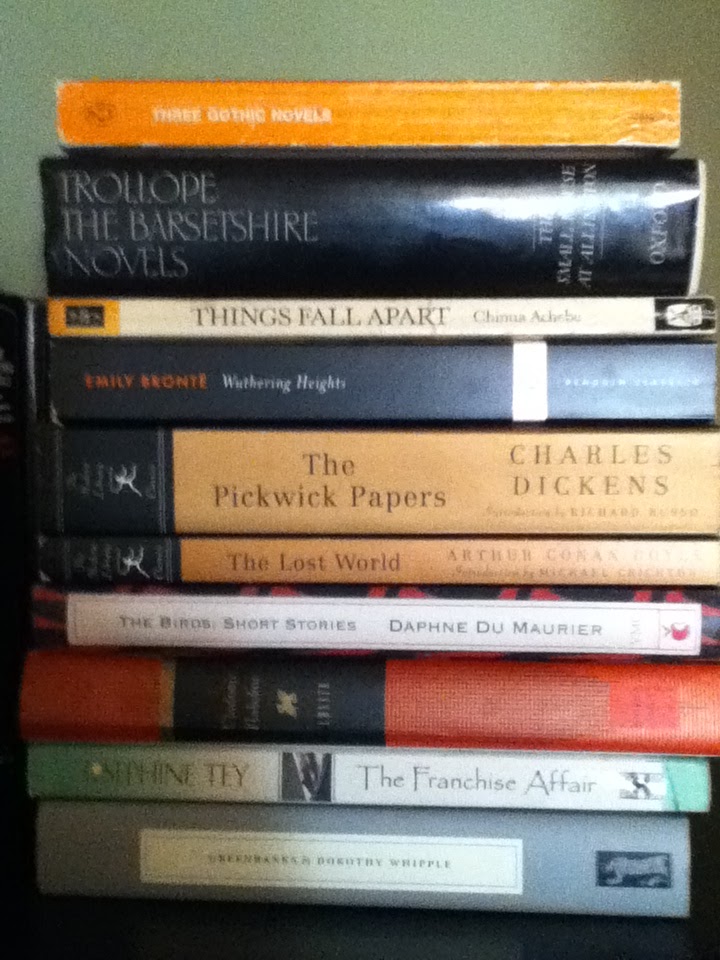
 I am hoping to read as many titles from my actual shelves as possible and then supplement with library books as needed. The only book that I might need to buy would be Evalina.  Below are some of the books that I already have on hand that would fill ten of the categories easily!